



Revisiting Ditró
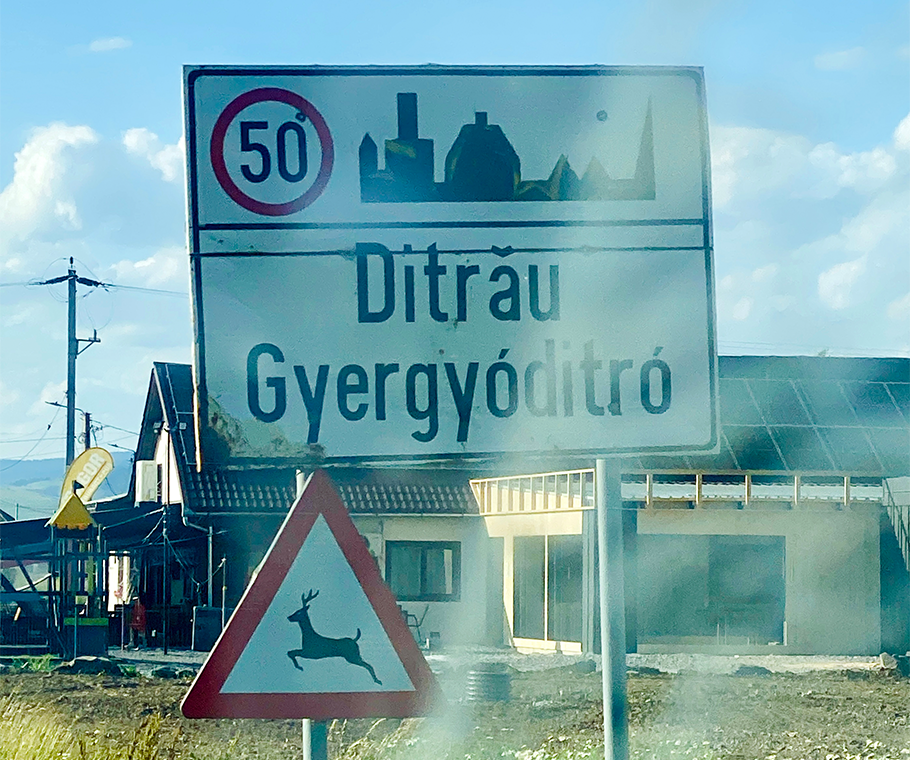
Set in the context of Romania’s transformation from the labour frontier of the West into the destination of a growing number of third-country ‘migrant workers’, Revisiting Ditró develops a case study around the country’s first anti-immigration protests following the arrival of Sri Lankan workers to the rural Transylvanian Hungarian municipality of Ditró (or Ditrău), in January 2020. This study revisits the case and contributes to its reconceptualisation as twofold, based on parallel national and local frameworks of interpretations. For the analysis of the national level, on the one hand, we carry out the mapping of mainstream media and examine the way they portray the incident as xenophobic and racist, the locals as right-wing extremists, and the Sri Lankans as merely ‘migrant workers’, turning the ‘Ditrău incident’ into Romania’s first and most important nationwide migration debate. This involves analysing what the coverage of immigration-related events in Romania tells us about the country’s approach to immigration, and how the symbols, signs, languages, meanings, knowledges, and memories articulated around the ‘Ditrău incident’ make this and other relatable events feed into this approach. We employ discourse analysis, including Lotman’s cultural semiotics, and engage with the institutional, political, and historical framing of ‘the incident’, as well as the broader socio-political and historical context of Romania’s immigration debate. In this way, we argue the following:
• First, the ‘Ditrău incident’ was instrumental to Romania’s ruling class in the self-representation of the majority or core group of society as closer to ‘the West’, its absolution of any responsibility for xenophobia and racism, the reproduction of the hegemony of neoliberalism and the middle-class ideology, and the construction or maintenance of the category ‘diligent migrant workers’.
• Second, ‘the incident’ was fundamental in the silencing, individualisation, and invisibilisation of working-class voices, primarily particularising Transylvanian Hungarians as racists and extremists.
• Third, it allowed Romanian mainstream actors to brand their nation as open, tolerant, and humane, while normalising the commodification and overexploitation of third-country migrant labour.
For the understanding of ‘Ditró’ at a local level, on the other hand, we provide a framework for the broader analysis of anti-immigration manifestations at the intersection of class, race, and ethnicity. Our starting point is the premise that an insufficient labour force needs to be dealt with foreign labour. We revisit this affirmation in the capital-accumulation-immigration nexus to understand it as having the increase of profits as its principal objective and the importation of cheaper, (more) precarious, or (partially) free foreign labour and/or the replacement of existing workers as its routine procedure. More specifically, in this nexus profit accumulation requires permissive immigration policies and an accepting public opinion, and the racialisation of labour to coexist in such a way that employment inequalities and welfare entitlement are conceived of as natural and immutable. In this way, we contribute the following:
• First, the events in Ditró were primarily driven by working-class collective action against precarity and the prospect of replacement.
• Second, racism emerges in the construction of developmental hierarchies among the ethnic Hungarian protesters and partly because of their borderland condition, as they stand, at the onto-epistemic level, between Viktor Orbán’s illiberalism and Romania’s progressive neoliberalism.
PUBLICATIONS _
2026 | LUIS ESCOBEDO & TAMÁS KISS
_‘Romania’s immigration debate under neoliberal hegemony: Constructing diligent migrants and individualising Transylvanian Hungarians as racist.’ European Journal of Political Research. Published online 2026:1-22. doi:10.1017/S147567652610187X [Read here]
_‘The Migration Turn and Eastern Europe: De-homogenising the abstract category of “migrant”.’ Review of Melegh, A. (2023). The Migration Turn and Eastern Europe: A Global Historical Sociological Analysis. Palgrave Macmillan. Intersections. East European Journal of Society and Politics. 10, 1 (Aug. 2024). [Read here]
2024 | Luis Escobedo
_‘A migrációs fordulat és Kelet-Európa: a “migráns” mint homogén kategória meghaladása,’ translated by Kyra Lyublyanovics. Review of Melegh, A. (2023). The Migration Turn and Eastern Europe: A Global Historical Sociological Analysis. Palgrave Macmillan. Eszmelet, 142: 110-117. [Read here]
_‘The Migration Turn and Eastern Europe: De-homogenising the abstract category of “migrant”.’ Review of Melegh, A. (2023). The Migration Turn and Eastern Europe: A Global Historical Sociological Analysis. Palgrave Macmillan. Intersections. East European Journal of Society and Politics. 10, 1 (Aug. 2024). [Read here]
PRESENTATIONS _
2025
_‘Reconstructing a “xenophobic incident” from the local perspective,’ Belonging and trauma (panel), Prague Visual History and Digital Humanities Conference 2025, Malach Centre for Visual History, 23-24 January, Prague. [Read here] + [Read here]
2024
_Guest Speaker, ‘El Giro Migratorio y el Orden Étnico Racial: Significados, debates e historias visuales de resistencia’ (The migration turn and the ethno-racial order: Meanings, debates, and visual stories of resistance’) (seminar), UNIFSL-B, 17 July, Bagua, Peru. [Read here] + [Read here] + [Read here]
_Guest Speaker, ‘El Giro Migratorio y el Orden Étnico Racial: Significados, debates e historias visuales de resistencia’ (seminar), INAAK, UNTRM Faculty of Social Sciences, 15-16 July, Chachapoyas, Peru. [Read here] + [See here]
_‘Epistemic Injustice in Romania’s Immigration Debate: The Weaponization of Collective Memory through Film Representation,’ Minorities as Romania’s Geopolitical Challenge (panel), Challenges of Plural Societies, International Political Science Association (IPSA, Research Committees 14, 23, 28, 50, 53), 28-31 May, Chișinău, Moldova. [Read here] + [Read here]
2023
_‘El Giro Migratorio: Significados, debates e historias de vida sobre “migración” y “migrantes”’ (The Migration Turn: Meanings, Debates and Life Stories around ‘Migration’ and ‘Migrants’), and ‘Métodos Mixtos de Investigación sobre “migración” y “migrantes”’ (Mixed Methods for Research on ‘migration’ and ‘migrants’) workshops, UNTRM Faculty of Social Sciences, 5 November – 3 December, Chachapoyas, Peru. (online)
_‘Revisiting Ditró/Ditrău: Challenging Media Representations, Reconstructing Local Frameworks and Memories’, The Settler Colonial Present (panel), Settling and Unsettling: Towards a “Settler Turn” in the Study of the East of Europe (1700s – Present), Conference of the Institute for Danube Swabian History and Regional Studies, 12-14 October, Tübingen, Germany. [Read here]
_‘Revisiting Ditró/Ditrău: Challenging Media Representations, Reconstructing Local Frameworks and Memories’, Migration Dialogues. Engaging Research, Policy and Civil Society, Romanian Network for Migration Studies (RoMig), National School of Political and Administrative Studies (SNSPA), 7-8 September, Bucharest, Romania. [Read here]
_‘How the Romanian Media Constructed the Racist Transylvanian Hungarian Town’, The Contributions of Interpretivism, Narrative and Autoethnography to Political Science (panel), & Memory Activisms: An Opportunity to Re-envision Politics and Political Science (panel/special session), IPSA/AISP 27th World Congress of Political Science, 15-19 July, Buenos Aires, Argentina. [Read here]
_‘Revisiting Ditró/Ditrău: Challenging Media Representations, Reconstructing Local Frameworks and Memories’, ASN Europe 2023: Reframing Nationalism and Populism in the Context of Securitization: Political Struggles and Scholarly Debates, 6-8 July, Cluj-Napoca. [Read here] + [Read here]
_‘Revisiting Ditrău/Ditró: Building a (new) political community and (re)producing ethno-racial hierarchies in the face of migration,’ 2023 ASEN Conference of Nationalism and Multiculturalism, 3-5 April, Loughborough, UK. [Read here]
MEDIA _
2025
_‘Perspectiva utilitară asupra migrației de muncă,’ Radio România Internațional, 12 March, Romania. [Read here]
2024
_A Szem, ‘Panoramă despre Maifest, organizat de SZEMinárium,’ Új Szem, 27 May, Cluj-Napoca, Romania. [Read here]
_‘Luis Escobedo,’ Regard, la lettre, 7 March, Romania/France. [Read here]
_David Borchin, Tagungsbericht: Settling and Unsettling: Towards a “Settler Turn” in the Study of the East of Europe (1700s – Present), In H-Soz-Kult, 26 January, Germany. [Read here]
_Cristian Cercel, Settling and Unsettling: Towards a “Settler Turn” in the Study of the East of Europe (1700-Present), In Südosteuropa Mitteilungen, vol. 1, January, Germany. [Read here]
2023
_Iulia Hau, ‘“Mâini negre pe pâine albă”: doi cercetători construiesc o altă imagine a scandalului xenofob din Ditrău și susțin că presa a redus la tăcere perspectiva locală,’ Prezentul continuu, PressOne, 28 November, Romania. [Read here]
_‘Vendégmunka a félperiférián: mint Szauron szeme, keresi a magyar politika, hogy kitől lehet rettegni’ (Foreign labour at the semi-periphery: Like Sauron’s eye, Hungarian politics is looking for someone of whom to be afraid), Mérce, 11 November, Hungary. [Read here]
_Márk Sima, The Association for the Study of Ethnicity and Nationalism Conference – Loughborough, 2nd – 5th April 2023, Stanowiska I Sprawozdania, Przegląd Geopolityczny, 44, 2023, s. 161-170. [Read here]
2020
_AdminLarics, ‘Cum s-a văzut cazul Ditrău în Ungaria? “Un Ditrău fără migranți” – mesajul Budapestei în Ardeal,’ Larics, 2 March. [Read here]
_Tamás Kiss and Tibor Toró, ‘Note despre cazul Ditrău,’ Observator Cultural, 26 February. [Read here]